We take for granted the legislation and safety protocol that keep us safe at home, school, and work. Yet, these laws had to be proposed and passed to standardize safety protocols. Until 1898, for example, trains weren’t required to have automatic brakes. Think about that for a moment.
Unfortunately, many safety laws came about because of devastating workplace accidents. One of the worst in history was the Triangle Shirtwaist Factory fire, which occurred on this day 109 years ago. Watch this video from the History Channel. PBS American Experience series also has an episode on this topic, available here. (Note that it is more detailed and graphic than the clip below).
Read this detailed history of the tragedy. Answer these questions: 1. Who was employed at the Triangle Shirtwaist Factory? 2. What were the working conditions like? 3. How did the fire begin? 4. Why did so many people perish? How could their deaths have been prevented?
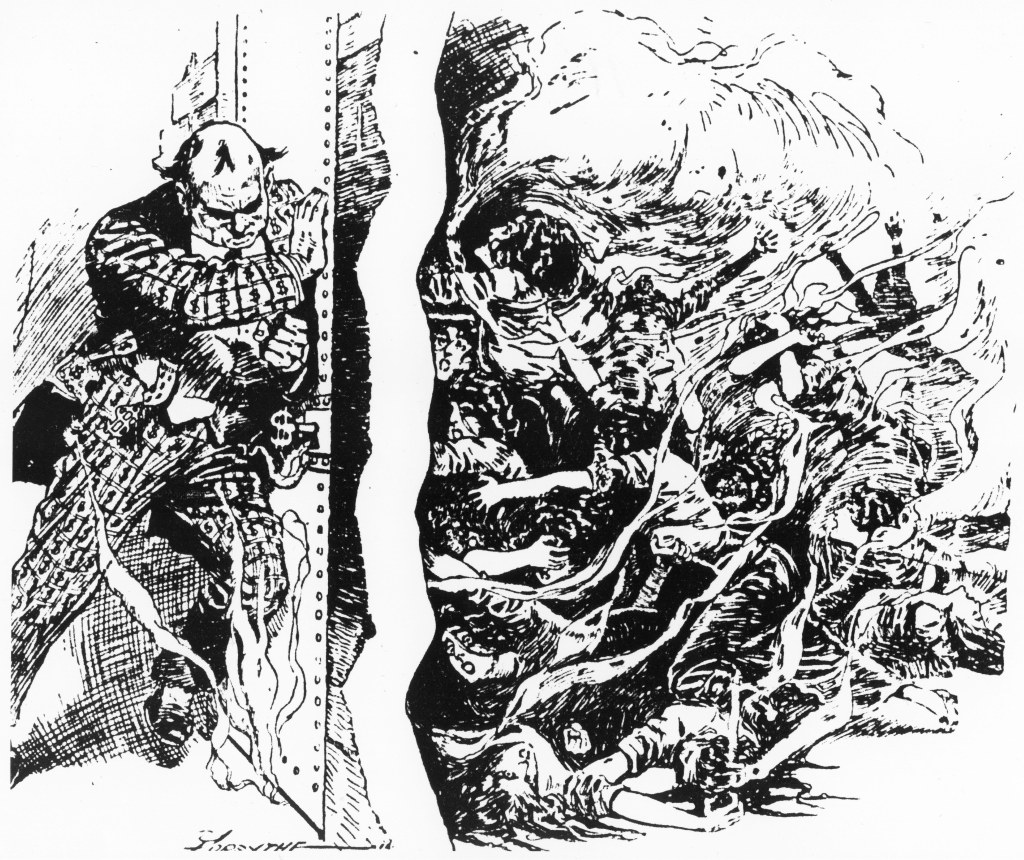
The fire spurred demands for improved working conditions. Newspapers covered the protests, trial, and movement toward laws about workers’ compensation and factory regulations. Editorial cartoons on the topic helped garner support for change. Look at this editorial cartoon and then Cornell University’s collection.
What messages are conveyed? How could these cartoons persuade readers to believe that change is necessary?
Many other horrific workplace accidents have happened because of a lack of safety measures. Although it is grim to think about, these tragedies led to reform and legislation that greatly shaped working conditions for future generations. Why do you think laws had to be passed to reduce workplace dangers? What laws pertain to safety that are in place today? Research the history of the Occupational Safety and Hazard Administration (OSHA) to learn about contemporary regulations.
More than 900,000 podcast shows are currently running, a number that continues to climb. Why are they so popular, especially among younger consumers? Just as important, how did they come to be?
It’s interesting to think that this seemingly new phenomenon is actually one of our older forms of entertainment. Just like podcasts, radio shows of the 1920s-1940s appealed to an array of listeners and spanned genres. In fact, many of our TV genres came from radio. People listened to sports broadcasts, news, cooking shows, competitions, and variety spots, backed by live musicians. Fictional programs were also common, with westerns, mysteries, soap operas, comedies, and kids’ shows. Listen to the first radio episode of the Adventures of Superman:
This 1938 short film shows the making of a radio western:
As you can see here, sound effects were an important part of radio production. You might also remember this scene from the 1982 film version of Annie:
This article provides a good overview of the process of creating sound effects, not with a computer, but with common household objects.
Listen to the introduction to The Adventure of Sam Spade (1948):
Note how the advertiser is mentioned several times within the introduction. Now listen to the set up. How does the music set the tone? How do the characters set up the story? Can you picture the characters? How do they establish the scene without visuals? What sound effects do you hear?
Creating your own radio show First, figure out what kind of show would you like to make. A western, like the first video? Variety show? A mystery? Once you’ve determined the genre, start planning out your specifics. How many people or characters will you have? Describe the people involved and the setting for your show. Remember, you don’t need costumes or sets, but you should be able to paint a picture for your audience using descriptive language.
Plan out the story. If it’s a variety show, who will host? What will your acts be? For fiction, who is the main character? Other characters? Villain? What will happen in your story? When? Have a script or clear plan for your show and create a fitting title.
Next, think of the extras. Which parts of your show could use sound effects? Identify the sound and then the household object you could use (ask your parents first). For example, rice poured into a bowl can sound like rain. Find shoes with hard bottoms to exaggerate footsteps. Gather your items and plan out when they will be used.
Finally, figure out a fake sponsor of your show–any product will do, but it’s even better if it ties into the theme and/or audience of your show. Listen to the incorporation of Ovaltine into this original 1936 Little Orphan Annie broadcast. Use a similar pairing for your show.
Once you’ve planned out your show and its sponsorship, rehearse your show several times through before you perform or film it. Everyone involved should know what to do and when, including the sound effects.
When you are ready, either perform your show live or have someone film it (share on Facebook, if you’d like). Have fun! You could even do a podcast in which you reflect on the experience.
Why can’t we have sleepovers, play on the playground or go climbing? What have you heard about coronavirus (COVID-19)? How does it spread? Who can get it? What happens if you do get sick? At this point, I’m sure you’re heard a lot of different pieces of information, most of it probably from other people. Today, I want you to focus on doing your own research, gathering facts from credible sources.
What are credible sources? “Credible sources” refer to organizations and media outlets known for producing fact-based, trustworthy information that has undergone a gatekeeping process (meaning several tiers of people check and verify the information before it is released to the public).
We’ll start with health organizations. For health issues, the Centers for Disease Control and Prevention (CDC), national public health institute for the United States. Use the CDC’s resources on COVID-19 to answer the following questions:
1. How does the COVID-19 spread? 2. What are the symptoms of COVID-19? 3. How can your family prepare if someone gets sick? What should you do?
The World Health Organization (WHO) is a global public health agency and has produced wonderful resources about COVID-19. Look at WHO’s page of mythbusters. Identify 3 myths about what can kill the coronavirus.
We can also turn to news outlets for information. Like other news sources, The New York Times and The Washington Post have produced a plethora of stories on coronavirus, covering many angles on what it is, how the disease affects groups of people, and its profound impact on society. With news stories, it is important to look at the source and the date. Articles written about coronavirus in January had a very different purpose and tone compared to stories produced this week. Compare this January 29th story: “New York is Bracing for the Coronavirus” to this one from today, in which there are more than 15,000 cases: “New York Prepares for a Week at the Pandemic’s Center.” What was the purpose of each story? How has the tone shifted?
Compare local news to national news or look across media platforms. Broadcast news stories (television news) are packaged differently than ones created for print and online sources. For example, watch this Nashville News Channel 5 broadcast and discuss its focus.
What are not credible sources? We have what feels like unlimited media choices. It can be hard to tell what sources we should trust. How do you determine what are not credible sources? If “information” does not have to pass through a gatekeeping process (or doesn’t reference a source that does), it may not be credible. Social media posts, blogs, memes, email forwards, and personal websites are all examples of media content with no screening process. Anyone can create posts or memes and publish them, without others checking the information.
This doesn’t mean that we can’t learn from these types of media products, but take them with a grain of salt (be a little skeptical about the information). This means that if you read something about coronavirus on social media or on a website, look up the information using a credible source (organization or news outlet-produced) before you believe it, or even worse, share it with others.
For example, a number of people shared this meme on social media about preventing coronavirus by gargling salt water [FALSE INFORMATION].
Why do you think people believe in such “remedies?” Even worse, why do people share “information” even though it has no factual basis?
News stories and factual resources are vital at this tough time. Knowing where to look for credible information will help us stay updated and not be misled by fake remedies or other myths of the coronavirus.
This meme is going around social media. Along with these:
Plus parody songs that time washing hands, instructional videos on how to get that lather, and a shortage of anti-bacterial soap that demonstrates people are listening.
So I don’t seriously think you should stop washing your hands. It should have been standard practice. And yes, we could all use a little reminder to linger at the sink and up our thoroughness.
That said, I have several issues with this message as the dominant onewe’re still reciting, meming, and sharing. Back in January, this “wash your hands” campaign was a good introduction to the escalation about to come. And yet we’ve spent more time repeating this phrase than sharing vital information from the CDC, World Health Organization, public health departments, and other sources.
We are past the initial stage of the crisis and should be focusing on identifying symptoms, where to go for testing, how to protect yourself from infecting others, and what to do for yourself if you don’t need hospitalization. This is the information we should be spreading online.
Using risk language (like in the meme above) simplifies disease transmission into a Magic Bullet Model. Under this falsely-conveyed causation, if you test positive for COVID-19, then you must have failed at washing your hands or not touching your face. This is not how disease works. Transmission, susceptibility, and immunity are complicated. We don’t know exactly how each person got infectedso we need to stop assigning blame for those yet to be infected. And with that, stop blaming people from other countries too. It won’t protect you. Instead, treat everyone like they are Tom Hanks, Rita Wilson, or Idris Elba.
Here’s the deal: We need regular people to feel comfortable coming forward and sharing their personal experiences so stop stigmatizing individuals who have tested positive (and the many who likely have the disease but aren’t being tested). It is helpful to hear about the varied unfolding of this disease and how it affects different people. We should be thinking about how we can best be prepared and help out, not accusing others of improper hand washing. The when is here. It’s time to shift our own messages accordingly.
In this isolated time, we can appreciate the value of our teachers and educational system. School wasn’t always considered a right, especially one that was extended to every child. For this lesson, we use media sources to examine 19th century schooling and the various obstacles that prohibited many kids from receiving an education.
Starting in the 1830s, The Common School Movement led to the development of public schools, which offered free education to all children (more on its limits below) For kids who were lucky enough to go, what was school like in the 1800s? In rural areas, many children learned in one-room schoolhouses, if they lived close enough to walk. Kids across ages gathered together under one teacher.
These country schools existed into the 20th century so you may know people that attended them. Call and ask about their experiences. Some questions to ask: —How did you get to school? —What was it like to have multiple age groups under one teacher? —How was the day structured? —Did your school have indoor plumbing? How was it heated? —How were children disciplined?
Who didn’t get to go to school?–African American Children Not every 19th century child got to attend school. Some groups of kids were not allowed to go to school. Seven states had anti-literacy laws that prohibited enslaved and free children from learning to read and write. Read here about the history of African American education. Then watch this overview. Why is literacy so important?
Who didn’t get to go to school?–Children with Disabilities Some children with disabilities were also left out of the Common School Movement. Unfortunately, inclusive education wouldn’t happen until the late 20th century. Watch the video below. Why did it take so long for the United States to provide education for everyone?
Who didn’t get to go to school?–Child Laborers Other kids couldn’t attend school because they had to go to work to earn money for their families. The number of children working grew over the the 19th century. In 1900, approximately 18% of children ages 10-15 were employed.
Photo by Lewis W. Hine / Public domain “10 years old. Working 3 summers. Minds baby and carries berries, two pecks at a time. Whites Bog, Brown Mills, N.J. This is the fourth week of school and the people here expect to remain two weeks more. Witness E. F. Brown. Location: Browns Mills, New Jersey.”
With adult supervision, research online to answer the following questions: 1. What were some of the jobs held by children? 2. Describe the conditions for these jobs. Were they dangerous? How many hours did kids have to work per day? 3. Why did children have to work? 4. When did child labor become prohibited in the United States? Why?
Reflection Essay In a short essay, identify three reasons that prevented children from getting to attend school. Next, discuss why school and good teachers are so important. What would your life be like if you weren’t allowed to go to school?
I spent the past few years trying to find out everything I could about disease and the impact of epidemics on society. For each of the outbreaks featured in my book (and for some that didn’t make the cut), I did my best to bring together every tiny piece of information or perspective that would help me better understand what how the crisis unfolded. Over the last few months, weeks, and days, I have felt an eerie sense of dejá vu.
Cycle of an epidemic. The narratives of epidemics seem to follow an Aristotealean plot structure, with the story shifting into crisis mode, the escalation–marked by fear and panic, and then finally a resolution, marked by reassuring promises and optimism before eventually returning to the new normal. It is both intriguing and disturbing how states have varied on their own perception of the current stage.
Innovation in creating transforming spaces into hospitals. As cases outnumber hospital beds, public health authorities have had to get creative, turning houses and other spaces into makeshift medical facilities. In 1944, when a polio outbreak overtook the town of Hickory, NC, the National Foundation for Infantile Paralysis helped transform a summer camp into a hospital in just three days. It was heralded as the “Miracle of Hickory.” As exemplified in this story about the Comfort ship in New York, public health authorities are already seeking facilities that could potentially become treatment centers.
Prejudice, Stigma, and Blame. Fear and uncertainly lead to misconceptions about disease origin and transmission. Too many times in the past and now, people blame a race, culture, and/or place for somehow “bringing” or causing an outbreak. I’m intentionally not going to give historic or current examples here. Stop profiling and recognize that contagions have always emerged. Focus on what unites us. We need global cooperation, not racist misinformation.
Opportunists Capitalizing on Crisis. Unfortunately, epidemics also bring out the unscrupulous, those trying to make money off of panic, fear, and tragedy. Physicians and laypeople alike used to concoct their own “medicine” and advertise it in the local papers.
From The Federal Gazette, October 2, 1793, p. 2
Today’s regulation makes it more difficult for people to market their products as “cures.” However, we can certainly lump the hand sanitizer misers and TP hoarders selling their overpriced stockpiles into this category.
Emergence of Quack Remedies & Myths. On a related note, the profiteers are only successful because this is a vulnerable time. Without scientifically-backed cures (and sometimes with them), people have always come up with their own ideas about disease, which is exacerbated during epidemics. Past “cures” for various contagions have included smoking cigars (even for children), gunpowder, turpentine, enemas, hot air balloon rides, drinking blood, and onions. Some of these are not too far off of the COVID-19 “remedies.” No, drinking salt water will not kill the virus, despite the claims of a popular social media post.
Unsung Heroes. The good of humanity to pitch in and help. On the bright side, epidemics also bring out the helpers. Health professionals, clergy, volunteers, and others step up to assist those in need, risking their own lives so that others can receive treatment, food, clothing, and/or comfort. Notably, numerous members of the Free African Society worked tirelessly in the 1793 yellow fever epidemic in Philadelphia. Many succumbed to the disease themselves.
We are already seeing unsung heroes in action. In as much as we recognize health professionals, we also need to praise food program distributors, grocery store clerks, sanitation workers and others who keep society together. It is and will be the helpers that push us through.
Creating comic versions of popular (or unpopular) content is an old practice. For example, the first film parodies were created shortly after the first movies, with The Little Train Robbery (1905)–after TheGreat Train Robbery (1903).
So what makes for good parody? Comedy is personal. What is funny to one person may be groan-worthy to another. That said, we can still identify shared characteristics of well-received parody.
1. Parody should draw on a familiar song, TV show, movie, or other text. It can also be broader, playing off common themes or cultural phenomena, like with the Austin Powers movies. The original reference needs to be immediately recognizable. Assuming you know The Fresh Prince of Bel-Air theme song, it’s easy to recognize it here.
2. Good parody incorporates elements of the original throughout, but in a new fun way. Check out the trailer for Spaceballs (1987).
3. Some parodies are relatively timeless, like the Naked Gun series or Airplane. Most parodies, though, work because they relate to the moment. Like this one on social distancing:
Find your own examples of parodies. What makes you laugh? What doesn’t? How does familiarity with the original make the parody funnier? You can also try creating your own parody, taking an original and putting your own spin on it.
Parody Recommendations (not divided by age)
Top parody movies. I advise watching the original films first.
Even without Facebook or other social media, we know what many people in the past were thinking and feeling because they kept daily journals. We are in a strange time right now, with a lot of uncertainty. You may not remember how your thoughts changed from day to day unless you write them down.
Start a journal of your time at home. Before bed, reflect on each day. 1. What did you do? 2. How did you feel? What made you happy? Frustrated? Impatient? Angry? 3. What parts of the the day would you like to repeat tomorrow? 4. How can you avoid repeating the tough moments?
Our technology has changed so much over each decade. It really wasn’t that long ago that you had to stay home to receive a phone call or that distance-learning meant by mail. Of course, not everyone buys a new device when it first comes on the market. Bringing home a TV, computer, or phone used to be a big deal. So big, that it was memorable!
Most older generations can remember when and why they first got television sets, VCRs, and computers and love to share their stories. For this scavenger hunt, interview different people about their experiences to complete the activity. Here’s a printable link.
Have you ever thought about cereal marketing? First, let’s watch two (delightfully vintage) ads for cereal. View the Rice Krispies ad above. Now watch this 1950s Heart of Oats ad:
1. Who is the target audience? Why? 2. How do we know these commercials are not from 2020? Why do they feel “old?”
Let’s move on to contemporary cereal advertising.
Look at the Rice Krispies on the left. 1. What does this box say about who Kellogg’s wants to attract? 2. How about the purple Cheerios box? What is the main draw here? 3. Why are kids’ cereals placed on the lower shelves at grocery stores?



 Dr. Katie Foss