On this site, you will find blog essays on epidemics, media literacy activities, and writing. Check out the page in which people share their experiences with different diseases of the past.
Order my new book:
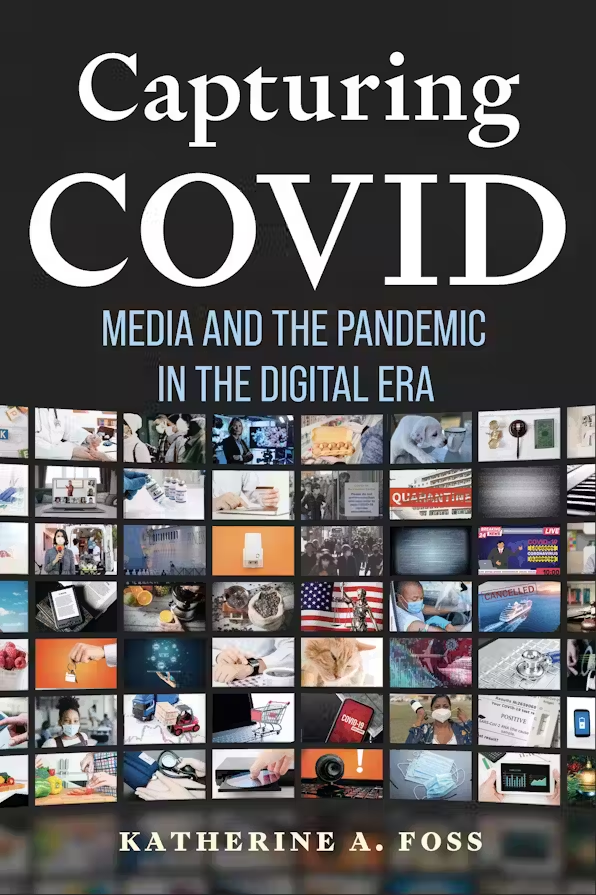
Capturing COVID: Media and the Pandemic in the Digital Era
Recent Publications
Foss, K. (2023). “Remember to breathe (but don’t make a sound!)”: Constructions of childbirth in post-apocalyptic narratives. Feminist Media Studies, 23 (3), 735-749.
Schneeweis, A., & Foss, K. A. (2022). “I Don’t Want to Die in Here”: Absence and Vulnerability in COVID-19 News Coverage of Prisons. Journal of Communication Inquiry, 01968599221141082.
Perreault, M. F., & Foss, K. (2022). Parents’ News Consumption and COVID Sources in Their Decisions to Vaccinate. Journal of Applied Research on Children: Informing Policy for Children at Risk, 13(2), 3.
Foss, K. A. & Gloviczki, P. (Eds). “Considering COVID: Critical Media Scholarship in an Uncertain Time.”A Special Issue of Journal of Communication Inquiry.
Some of my popular articles:
“What’s in a name for the vaccine? Maybe the end of the pandemic,” The Conversation, 2 March 2021.
“The blueprint for Biden to create a successful coronavirus vaccination campaign,” The Washington Post, 22 January 2021.
“Remote Learning isn’t New: Radio Instruction in the 1937 Polio Epidemic,” The Conversation, 5 October 2020.
“How the 1918 Pandemic Got Meme-ified in Jokes, Songs and Poems,” Smithsonian Magazine, 31 July 2020. Also published in Slate.
Why we should stop using “Typhoid Mary.” ##TyphoidMary – now a hashtag – was a maligned immigrant who got a bum rap,” published in The Conversation.
See my article “How Epidemics of the Past Changed the Way Americans Lived” in Smithsonian Magazine.
My most recent books:
Check out the University of Massachusetts Press site for my book on the history of epidemics in media:

Book Description
When an epidemic strikes, media outlets are central to how an outbreak is framed and understood. While reporters construct stories intended to inform the public and convey essential information from doctors and politicians, news narratives also serve as historical records, capturing sentiments, responses, and fears throughout the course of the epidemic.
Constructing the Outbreak demonstrates how news reporting on epidemics communicates more than just information about pathogens; rather, prejudices, political agendas, religious beliefs, and theories of disease also shape the message. Analyzing seven epidemics spanning more than two hundred years—from Boston’s smallpox epidemic and Philadelphia’s yellow fever epidemic in the eighteenth century to outbreaks of diphtheria, influenza, and typhoid in the early twentieth century—Katherine A. Foss discusses how shifts in journalism and medicine influenced the coverage, preservation, and fictionalization of different disease outbreaks. Each case study highlights facets of this interplay, delving into topics such as colonization, tourism, war, and politics. Through this investigation into what has been preserved and forgotten in the collective memory of disease, Foss sheds light on current health care debates, like vaccine hesitancy.
Why read my book?
And The Graduate Student Guidebook: From Orientation to Tenure-Track, published by Rowman & Littlefield.
This anthology brings together the expertise of the AEJMC Board of Directors, offering advice on each stage of graduate school.
![The Graduate Student Guidebook: From Orientation to Tenure Track (Master Class: Resources for Teaching Mass Communication) (English Edition) by [Katherine A. Foss]](https://m.media-amazon.com/images/I/41TbbbGn8zL.jpg)
 Dr. Katie Foss