Stop Telling People to Wash Their Hands: The Myth of Responsibility in the Pandemic

Image may contain: one or more people, possible text that says 'Exhibit A...Coronavirus swab. Yes that is where the swab goes. So unless you'd like this done to you... u...stay home and wash your hands!!! Please. Facebook/MedicalMemes'
Meme going viral right now

This meme is going around social media. Along with these:

Plus parody songs that time washing hands, instructional videos on how to get that lather, and a shortage of anti-bacterial soap that demonstrates people are listening.

So I don’t seriously think you should stop washing your hands. It should have been standard practice. And yes, we could all use a little reminder to linger at the sink and up our thoroughness.

That said, I have several issues with this message as the dominant one we’re still reciting, meming, and sharing. Back in January, this “wash your hands” campaign was a good introduction to the escalation about to come. And yet we’ve spent more time repeating this phrase than sharing vital information from the CDC, World Health Organization, public health departments, and other sources.

We are past the initial stage of the crisis and should be focusing on identifying symptoms, where to go for testing, how to protect yourself from infecting others, and what to do for yourself if you don’t need hospitalization. This is the information we should be spreading online.

Using risk language (like in the meme above) simplifies disease transmission into a Magic Bullet Model. Under this falsely-conveyed causation, if you test positive for COVID-19, then you must have failed at washing your hands or not touching your face. This is not how disease works. Transmission, susceptibility, and immunity are complicated. We don’t know exactly how each person got infected so we need to stop assigning blame for those yet to be infected. And with that, stop blaming people from other countries too. It won’t protect you. Instead, treat everyone like they are Tom Hanks, Rita Wilson, or Idris Elba.

Here’s the deal: We need regular people to feel comfortable coming forward and sharing their personal experiences so stop stigmatizing individuals who have tested positive (and the many who likely have the disease but aren’t being tested). It is helpful to hear about the varied unfolding of this disease and how it affects different people. We should be thinking about how we can best be prepared and help out, not accusing others of improper hand washing. The when is here. It’s time to shift our own messages accordingly.

(And, yes, we wash our hands).

The Past Repeats Itself: Epidemics Then and Now

I spent the past few years trying to find out everything I could about disease and the impact of epidemics on society. For each of the outbreaks featured in my book (and for some that didn’t make the cut), I did my best to bring together every tiny piece of information or perspective that would help me better understand what how the crisis unfolded. Over the last few months, weeks, and days, I have felt an eerie sense of dejá vu.

Cycle of an epidemic. The narratives of epidemics seem to follow an Aristotealean plot structure, with the story shifting into crisis mode, the escalation–marked by fear and panic, and then finally a resolution, marked by reassuring promises and optimism before eventually returning to the new normal. It is both intriguing and disturbing how states have varied on their own perception of the current stage.

Innovation in creating transforming spaces into hospitals. As cases outnumber hospital beds, public health authorities have had to get creative, turning houses and other spaces into makeshift medical facilities. In 1944, when a polio outbreak overtook the town of Hickory, NC, the National Foundation for Infantile Paralysis helped transform a summer camp into a hospital in just three days. It was heralded as the “Miracle of Hickory.” As exemplified in this story about the Comfort ship in New York, public health authorities are already seeking facilities that could potentially become treatment centers.

Prejudice, Stigma, and Blame. Fear and uncertainly lead to misconceptions about disease origin and transmission. Too many times in the past and now, people blame a race, culture, and/or place for somehow “bringing” or causing an outbreak. I’m intentionally not going to give historic or current examples here. Stop profiling and recognize that contagions have always emerged. Focus on what unites us. We need global cooperation, not racist misinformation.

Opportunists Capitalizing on Crisis. Unfortunately, epidemics also bring out the unscrupulous, those trying to make money off of panic, fear, and tragedy. Physicians and laypeople alike used to concoct their own “medicine” and advertise it in the local papers.

From The Federal Gazette, October 2, 1793, p. 2

Today’s regulation makes it more difficult for people to market their products as “cures.” However, we can certainly lump the hand sanitizer misers and TP hoarders selling their overpriced stockpiles into this category.

Emergence of Quack Remedies & Myths. On a related note, the profiteers are only successful because this is a vulnerable time. Without scientifically-backed cures (and sometimes with them), people have always come up with their own ideas about disease, which is exacerbated during epidemics. Past “cures” for various contagions have included smoking cigars (even for children), gunpowder, turpentine, enemas, hot air balloon rides, drinking blood, and onions. Some of these are not too far off of the COVID-19 “remedies.” No, drinking salt water will not kill the virus, despite the claims of a popular social media post.

Unsung Heroes. The good of humanity to pitch in and help. On the bright side, epidemics also bring out the helpers. Health professionals, clergy, volunteers, and others step up to assist those in need, risking their own lives so that others can receive treatment, food, clothing, and/or comfort. Notably, numerous members of the Free African Society worked tirelessly in the 1793 yellow fever epidemic in Philadelphia. Many succumbed to the disease themselves.

We are already seeing unsung heroes in action. In as much as we recognize health professionals, we also need to praise food program distributors, grocery store clerks, sanitation workers and others who keep society together. It is and will be the helpers that push us through.

6 Epidemic-themed TV Episodes for Those Who Can’t Get Enough

The virus-themed films Outbreak and Contagion are now more popular than they ever were during their initial releases. But once you’ve watched Dr. McDreamy as Jimbo or Gwyneth Paltrow play Patient Zero, what’s next on your viewing list?
Across genres, many TV shows have done an “outbreak” episode (or an “almost outbreak” episode). Here are a few of my favorites:

6. Bones “The Pathos in the Pathogens” 8.23 (2013). A journalist is murdered by a human-made mutated virus. It becomes personal after one of the team members becomes infected. Unfortunately, the episode is more focused on the love story than the threat of the outbreak, but it’s still an interesting deviation from the usual Bones formula.

5. Little House on the Prairie “Plague” 1.18 (1975). Cheap cornmeal leads to a typhus outbreak in Walnut Grove. Charles Ingalls and others rush to find the source of the epidemic. This episode has all the elements of a great epidemic storyline. There’s tension, drama, and mystery as the death toll rises, while we, as the audience learn early on of the scourge’s source. My favorite of the numerous “outbreak” Little House episodes.

4. Criminal Minds “Amplification” 4.24 (2009). A serial killer releases anthrax spores to test the hypothesis of his master’s thesis. The BAU must work with CDC and U.S. Army to stop the unsub before he kills with disease. It’s high stakes, especially after one of the team becomes infected.

3. ER “Lockdown” 8.22 (2002). Several members of the ER are quarantined after two children are brought in with a smallpox-like virus. These episodes give a nice balance of drama with humor, as the quarantined health professionals struggle to pass the time.

2. The Walking Dead “Infected” 4.2 (2013). Rick and the other survivors battle a strange virus that spreads throughout the prison. This episode is a nice break from the usual threats in TWD.

1. Star Trek “The Way to Eden” 3.20 (1969). Space hippies bring a bacterium aboard the Enterprise. Besides the outbreak threat, it’s a delightful and interesting demonstration of mainstream fears of counterculture.

These are just the highlights. Sure, I could have included more medical dramas or westerns, but I especially enjoy these storylines when they appear in genres you wouldn’t expect.
For more recommendations, see this IMDB list.

We might get sick. Seriously. Flexible Teaching in the Pandemic

So far, our discussions on how to move online have focused on pedagogical questions and conferencing tools. I enjoyed reading one of the few essays to go against the grain–“Please do a bad job of putting your courses online.” Dr. Barrett-Fox’s reassuring narrative really gets at what most of us are feeling.

The other key point we need to center on is that many people will get sick. We are moving online because of disease. I’m not saying this to fuel the fire. It is a fact. We as faculty should prepare our courses in such a way that if (or when) we are too ill to teach, or too busy providing care, classes can still continue.

If we prep and release several weeks of material (video lectures, prepped assignments, quizzes, exams, discussion submission boxes), we also extend the same flexibility to our students, some of whom will also get sick. Even for the healthy ones, we don’t know their situations. They may not have computer access at home. Or slow internet. Or an older device that can’t download new apps.

Our students are across time zones right now and facing many unusual burdens that take away from learning. If we can create some material in advance, then we grant students the flexibility to work around their additional challenges. We can still connect by offering real-time conferencing, but only as a bonus, not for regular course delivery.

I know that many instructors are panicking about producing any materials and this task seems daunting. You will not be able to replicate your normal class or even its ideal online version. Boil down your regular lectures into short videos. Use technology that auto-grades quizzes and exams. Use the textbook’s additional resources and the free technology, provided that learning it doesn’t suck all of your time. Find Youtube videos that cover some of your course topics.

We as faculty also need to use each other as resources. If you create a video lecture with wider appeal, offer it to others. Senior faculty should reach out to junior faculty that teach the same course. Don’t let pride or fear hinder opportunities to make it through, especially as childcare options are falling through, forcing instructors and students to parent at the same time.

This is a weird time. We need to prep for the worst and hope for the best.

Timeline of an Epidemic on a University Campus

Right now, we’re all asking ourselves similar questions. What will happen? For how long? To what extent?
While no one really knows, we can look to the past for some guidance.

As we all know, from 1918-19, the duo of influenza and pneumonia hit nearly every region of the world. But how did it travel? And what was the timeline for one university campus?

Early March 1918: First evidence of the “Spanish flu” (influenza/pneumonia) at Camp Funston, Kansas.

Pneumonia at Camp Funston

Late March/Early April: Cases develop at the Haskell Institute, a boarding school for Native Americans and at the University of Kansas, located in Lawrence.
June-August: Influenza/pneumonia cases dwindle in the U.S. and appear across China and Europe, picking up the name “Spanish Flu.”
September: Outbreaks begin to spread across the U.S., especially in military camps. On the 27th, the Sigma Chi fraternity house is quarantined, then released the next day.
October 7th: A few cases in town.
October 8th: 98 men in the Student Army Training Corps (S.A.T.C.) had become ill. The state has 11,750 recorded cases.
Chancellor Frank Strong cancels classes and quarantines the campus, prohibiting students from leaving (expected to resume on October 15th). City schools and theaters close. Ban implemented on crowds of more than 20 people. Some businesses voluntarily close.
October 10th: Governor Arthur Capper officially closes all churches, theaters, schools, and “public places of assembly.” Organizations suspend their meetings. Children banned from “loafing on the streets.”
Rest of October-early November: Cases mount. Football games are canceled. The local Red Cross does a pajama drive and collects supplies. Boy Scouts distribute educational pamphlets as the local grocery store markets its onions as remedies. Vicks VapoRub is in high demand.
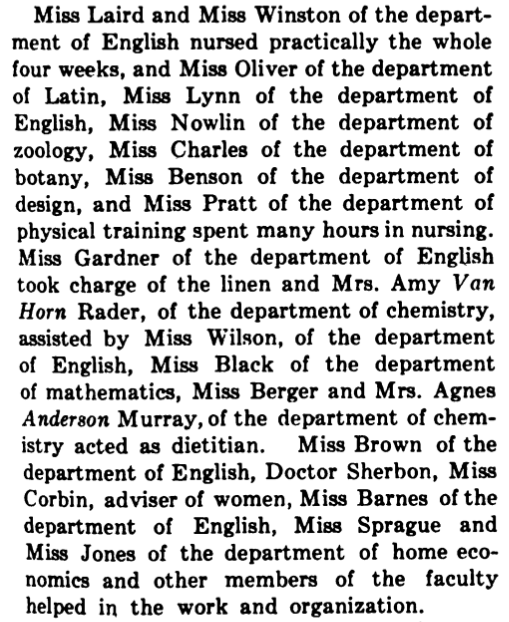
On campus, at least 18 female faculty across disciplines cared for patients, cleaned, and provided food. Their efforts were not recognized in newspapers or the KU yearbook, only in a single article.

From “Influenza,” The Graduate Magazine, University of Kansas, October 1918, 17(2), 45.
Faculty that helped (2)
November 2nd: Governor Capper lifts the ban. Regular activities begin to occur.
November 9th: The first regular season football game is played.
November 11th: KU is scheduled to reopen. Instead, World War I ends and everyone celebrates.
November 12th: Classes finally resume.
More than 1,000 people at KU became ill in the epidemic, with 24 deaths.

Keep in mind, this was before cellphones and computers. Before people had their own phones on campus.What did they do to pass the time? How did they suppress their concern for family members far away? The 1919 yearbook provides no clues.

As universities are moving classes online, we should be grateful that we are not confined to campus and that we can connect with students, family, and friends.