What the Archives Didn’t Teach Me About Life in a Pandemic

In researching my book, I spent months studying primary sources: newspaper articles, pamphlets, public health records, personal correspondence, diary entries and other materials. I never expected that I would see first-hand what a global contagious threat would look like in my life time. I had an idea of the progression of quarantine and the pattern of media coverage. At the same time, no book or microfilm prepared me for a number of aspects in this experience.

  • The Waiting Game: Nothing that I’ve read addressed what it is like to feel fine, have your family feel fine, but know that the danger is coming. . .for months and is not a matter of if, but when. I’m sure the people in the army camps of 1918 that got hit with the March/April wave of influenza felt similarly–just no one wrote about it.
  • Balancing Crisis Mode with Everyday Life: In the yellow fever epidemic of 1793, townsperson Elizabeth Drinker made daily notes in her diary that combined mundane activities like taking a walk with notes about the latest death toll and friends who had passed. I never imagined how strange it would be to do the basic things we have to do, like buy dog food, within the context of the COVID-19 cloud. Everything is the same, yet it’s not the same.
  • Some people are fools. Newspapers of the past occasionally mentioned individuals that broke quarantine and were then arrested. Since they didn’t have social media in 1925, for example, there weren’t Instagram photos capturing crowds flaunting their poor choices and lack of consideration for others.
  • Parenting in a pandemic: This is a big one that NO ONE talked about in the past. Children were part of past epidemics, of course, and were mentioned when they became ill and died, but the stories of active parenting during such a time were not documented and a preserved. As parents, it’s a tricky time. Not only are we juggling childcare and work, but we are also trying to balance crisis and despair with making sure our kids are fed, engaged, and have pretty good days. We have the added challenge of explaining and demonstrating this new reality without terrifying them and inciting panic. At the end of the day, our kids deserve to think that the world is good, they are safe, and this will pass.
  • How much I would miss the world during social distancing. I am certain that the groups of students quarantined at the University of Kansas and other schools felt lonely, bored, and isolated. However, we don’t have their personal testimonies about the experience. We are privileged to be safe here as a family. Yet, I will fully admit that I mourn our normal reality.
    Being extra-extroverted, I knew that I would have these feelings. But it’s not just my friends that I miss. I love being part of a community–like a normal one, in which you see the same faces at stores, parks, karate, and on campus. I miss teaching to human students sitting in front of me, even if they fall asleep sometimes. I want maskless faces to slightly breech the six-foot distancing just to chat for fun, comment on the weather, or to just return a “hello.” Someday we’ll get back to a new version of that world.

What does this all mean, aside from my own lamenting? We need to be writing our stories and recording the diverse experiences of others so that future generations can better understand what living at this time was like.

So you didn’t like The Sound of Music: Examining Generational Shifts in Viewing Preferences

As a kid, I remember my dad often hyping up a movie that he had seen years before. “I laughed so hard,” he told us repeatedly as we prepared to watch the 1965 western comedy Cat Ballou. My sister and I barely chuckled in the entirety of the 97 minute film. Yesterday, my girls had a similar experience with The Sound of Music. While they enjoyed the familiar music, they found the movie “too long,” “too romantic” and overall, “boring.”

20th Century Fox. Public Domain.

What shapes our viewing experience? First, let’s look at pop culture products that have made it through the test of time (in other words, contemporary audiences still “get” them). Watch this clip from Charlie Chaplin’s 1928 silent film The Circus:

What happened in the scene? How did Charlie Chaplin respond? Can we relate to his reactions? Why?

Many older films and TV shows aren’t quite as easy to understand. Some just haven’t aged well, meaning that what was considered funny, relevant, or appropriate when the film/show came out, is not now. Culture and technology changes so what seemed new, exciting, and acceptable at the time doesn’t always work for future audiences and may be offensive.

What about movies that parents love but their kids do not? Why do we have these differences in our consumption experience? One reason may be changes in how stories are told. Films used to slowly build a narrative, using plenty of dialogue to fill in each moment in the story. Although the kid and singing scenes in The Sound of Music move along, the adult exchanges are pretty slowly-paced and over-dramatized.

On the other hand, our post modern films and TV shows are more fast-paced and fragmented, assuming that audiences can fill in the pieces or that they don’t matter. Fewer lines of dialogue convey about the same thing. What is a film you didn’t like that your parents do? Why do you think that is?

Generation gaps happen the other way as well. You definitely enjoy books, music, games, shows, and movies that your parents either don’t understand or don’t understand why you like them. Here’s an example from our house:

I am not a fan of the books or movies, yet my kids love them because they can relate to the characters and have grown up reading graphic novels.

How about in your house? What do you like that your parents don’t? Why do you like the product? Ask your parents why they don’t like it. What explains the difference in opinion?

What movies from your childhood will you want to share with your future children?

My Favorite Things: Exploring the Story of the Sound of Music

The Sound of Music is based on a real Austrian singing family. Maria von Trapp wrote The Story of the Trapp Family, published in 1949, which was turned into a Broadway play. Its iconic film adaptation, starring Julie Andrews, came out in 1965.

How much of the story was changed for the film? Let’s research true story of the von Trapps, first in this Smithsonian article. Look at this interview with Maria von Trapp herself (who passed away in 1987):

What was the focus of the interview? What did you learn about the von Trapp family?

Movie time
Analyze the 1965 Sound of Music, exploring how the adaptation brought von Trapp’s story to the big screen. How does the opening song set the tone for the movie? What do you think of the main characters, particularly the depiction of Maria? How is Captain von Trapp portrayed? Identify some of the overarching themes of this movie. What does it say about childrearing and childhood during World War II? About sacrifice? How does the music bolster these messages?

“Christopher Plummer and Julie Andrews on location in Salzburg during the filming of The Sound of Music, 1964″
20th Century Fox / Public domain

Compare the real story to the film. What details remained the same for the film? What was changed? How did these changes impact the narrative? If you were to do an adaptation of Maria’s story, what would you have done differently? Think overall how real-life events and biographies shift when they become fictional movies.

Bonus
Watch the Carrie Underwood live version of The Sound of Music. What worked well in this adaptation? What could have been better? Why didn’t this version reach the same level of success as the 1965 film?

Nothing is normal. We’re in a pandemic. Shifting Expectations in the Midst of Crisis

In 1751, George Washington’s diary entries stopped for 24 days because he was ill with smallpox. Forty-two years later, the yellow fever epidemic in Philadelphia forced President Washington to relocate to Mount Vernon. Disruption due to disease was frequent and expected.

This pattern continued with other epidemic moments as well. When influenza hit in 1918, Kansas, like many states, canceled all group meetings and conferences, closed businesses and schools, and prohibited public loitering. The University of Kansas canceled all classes and mandated quarantine. Even though students were stuck on campus, they were not expected to continue their studies. Healthy male students practiced drills and smuggled cigarettes into the makeshift hospital for their ailing friends. Female students cared for the sick, but were also encouraged to go on hikes and roast hot dogs.

In the midst of an epidemic, historical precedent suggests that life dramatically shifts to revolve around the outbreak itself. We are in that moment. For months, we’ve seen it coming. Videos and images from other countries have been showing us what will happen, how bad it will become.

I’m not advocating that we completely shut down working from home, online learning, or virtual activities. However, we do need assume that everything we do, task we assign, and decision we make is shaped by the current and future reality of this global pandemic. Our expectations in our normal, pre-social distancing world do not directly carry over.

Even if we are fortunate to not be sick, the current situation dramatically influences all of our routines. A month ago, this was my typical Friday morning: Wake up, care for dogs, make breakfast, wake up kids, get kids and husband off to school, exercise dogs, do some writing or other work, drive to campus, hold office hours, teach, stop at the grocery store, eat lunch. Now my Friday morning consists of juggling parenting, attempted home-schooling, attempted online teaching, and attempted writing. Added to the mix are my worries and concerns unique to this time: Will the kids get to see their teachers or friends? Am I doing enough to help them through this? And then, the questions plaguing all of us: Will the stores have milk? What about people who are less fortunate than we are? How will local businesses survive? What will happen to the economy? Does it make sense to plan anything in the next 6-8 months?

At the same time, our face-to-face outlets for dealing with stress and working through situations have been cut-off. Without lunches with friends, gym workouts, or (gasp) in-person meetings, it’s hard to emotionally process it all. I’m glad that we can have online classes, connect over social media, and take virtual karate. But let’s not pretend it is the equivalent of the real experiences that we all crave right now.

My point is that we need to adopt a communal understanding about this time. Our standards and goals, even for daily productivity, should not be the same because our lives are not the same. What we do now will inevitably affect the future, but it doesn’t mean we are setting the bar (or lowering the bar) for next year and beyond. In other words, we need to asterisk * the things we think, decide, do, and communicate with the pandemic grain of salt.

This * is already happening for many people. If you are sick or care for someone who is, or if you work in healthcare, you are already there, where the details of a pandemic are all that concern you. A month into the yellow fever epidemic, every article in the Federal Gazette mentioned disease–even those that talked about a local fire. Every poem and parable printed focused on the epidemic. Ads only addressed “remedies” and other related goods and services. Even if we are lucky enough not to be in this place and can play with the kids, teach our online classes, and do “regular things,” we need to remember that not everyone shares our fortune.

This is a strange time full of uncertainties. Enjoy the moments that feel a bit normal, especially if they bring hope and optimism. But let’s also give ourselves permission to take a breath and just try for average, not exceptional, since every accomplishment is extraordinary right now. If Washington could ease up multiple times because of disease, then so can we.

Standing on the Shoulders of Giants: History of Technology Timeline

In 1676, Sir Isaac Newton wrote, “If I have seen a little further it is by standing on the shoulders of giants,” describing how his inventions (and those of others) existed because they built upon existing ideas and achievements. With this quote, he himself was improving upon an existing reference, paraphrasing from John of Salisbury’s 1159 Latin text Metalogicon.

Our current technology didn’t just emerge. Instead, technological developments evolve from prior technological developments. Media have played and continue to play vital roles in this innovation. Mass communication (or the ability to mass produce media content) isn’t just about providing books and newspapers. The ability to record ideas in a form that can be distributed profoundly affected all facets of life. With books, for the first time, people could build on others’ ideas then progress forward. You didn’t need to be within earshot to learn from another person. Many different people, often from different places, contribute to the success of an invention.
Let’s take the history of the car for example.


Depiction of 1908 Ford Model T Touring car, from Ford’s full-page advertisement of the first Model T in the Oct. 1, 1908 issue of Life magazine, volume 52, page 365.

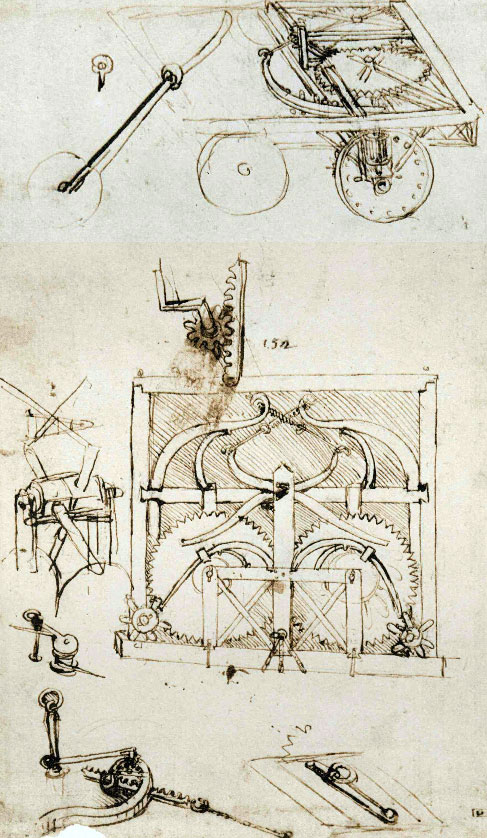
The Ford Motor Company didn’t just magically create a working car in 1908. They relied and improved upon existing car designs, created by Karl Benz in 1885 and Charles and Frank Duryea in 1893. These designers depended on earlier inventions and conceptualizations to make their automobiles work: the internal combustion engine, the carriage design and parts of a car. Oh, and the concept itself–that a vehicle could be self-propelled (conceived and invented by Leonard da Vinci in 1478).

Leonardo da Vinci / Public domain

Moving forward in time, this video conveys the many people involved from bringing the first cars to our modern day automobiles:

For each of these inventions, people could read about what had been done and then improve upon the existing designs.

History of Technology Timeline Activity
1. Choose something that we use in everyday life (an appliance, item of clothing, your phone or other entertainment technology, or anything that you are curious about).
2. Research the roots of that item. Identify all the different “players” that contributed–those who invented earlier models (even if they didn’t work) or pieces of the technology.
3. Using a large piece of paper, create a timeline that shows the evolution. For the car, we would start with da Vinci and map it out to today’s car. You could also depict this progression through a drawing or photo collage.

We take for granted the technology that we have. It’s important to remember that Newton was right. We must stand on the shoulders of giants to move forward.

The Space Race: Who was forgotten in the story?

As the book and movie Hidden Figures showed us, media coverage of the Space Race left out many important people. While space museums have added more exhibits featuring women, including women of color, most of these women were given little attention in their historical moment compared to the (white, male) astronauts and others who contributed to the first rocket launches. Check out this article.

For this activity, research one of the following great NASA women. What was her story? How did she come to work for NASA? What was her contribution to space exploration? Did media of the past (newspapers and television) tell her story in her moment? If so, how was she portrayed? If not, why do you think she was left out? Has her story been told since?

  • Dr. Thora Halstead
  • Dorothy Vaughan
  • Katherine Johnson
  • Dr. Christine Darden
  • Eleanor Francis Helin
  • Dr. Sally Ride
  • Dr. Shannon W. Lucid
  • Dr. Rhea Seddon
  • Dr. Kathryn D. Sullivan
  • Dr. Judy Resnik
  • Dr. Anna L. Fisher 
  • Nancy Grace Roman
  • Margaret Hamilton
  • Mae Jemison

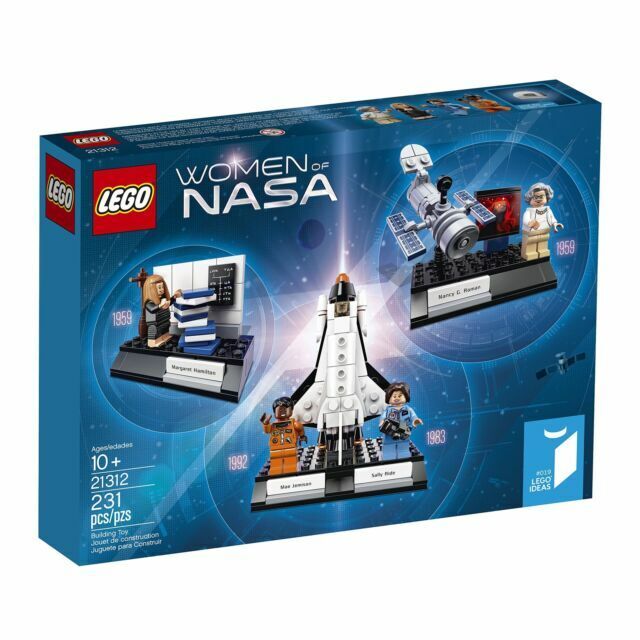
Now think about Hidden Figures and other ways that some of these stories have been captured and preserved in collective memory. For example, this LEGO set:

Stock photo

What is one shortcoming of this LEGO set? What else needs to be done to highlight these contributions? Why is it important to remember important female NASA pioneers and people of color who have been left out in the mainstream historical narratives?

For further reading, check out these books:

Learning from Tragedy: The Triangle Shirtwaist Factory

Kheel Center / CC BY (https://creativecommons.org/licenses/by/2.0)

We take for granted the legislation and safety protocol that keep us safe at home, school, and work. Yet, these laws had to be proposed and passed to standardize safety protocols. Until 1898, for example, trains weren’t required to have automatic brakes. Think about that for a moment.

Unfortunately, many safety laws came about because of devastating workplace accidents. One of the worst in history was the Triangle Shirtwaist Factory fire, which occurred on this day 109 years ago. Watch this video from the History Channel. PBS American Experience series also has an episode on this topic, available here. (Note that it is more detailed and graphic than the clip below).

Read this detailed history of the tragedy. Answer these questions:
1. Who was employed at the Triangle Shirtwaist Factory?
2. What were the working conditions like?
3. How did the fire begin?
4. Why did so many people perish? How could their deaths have been prevented?

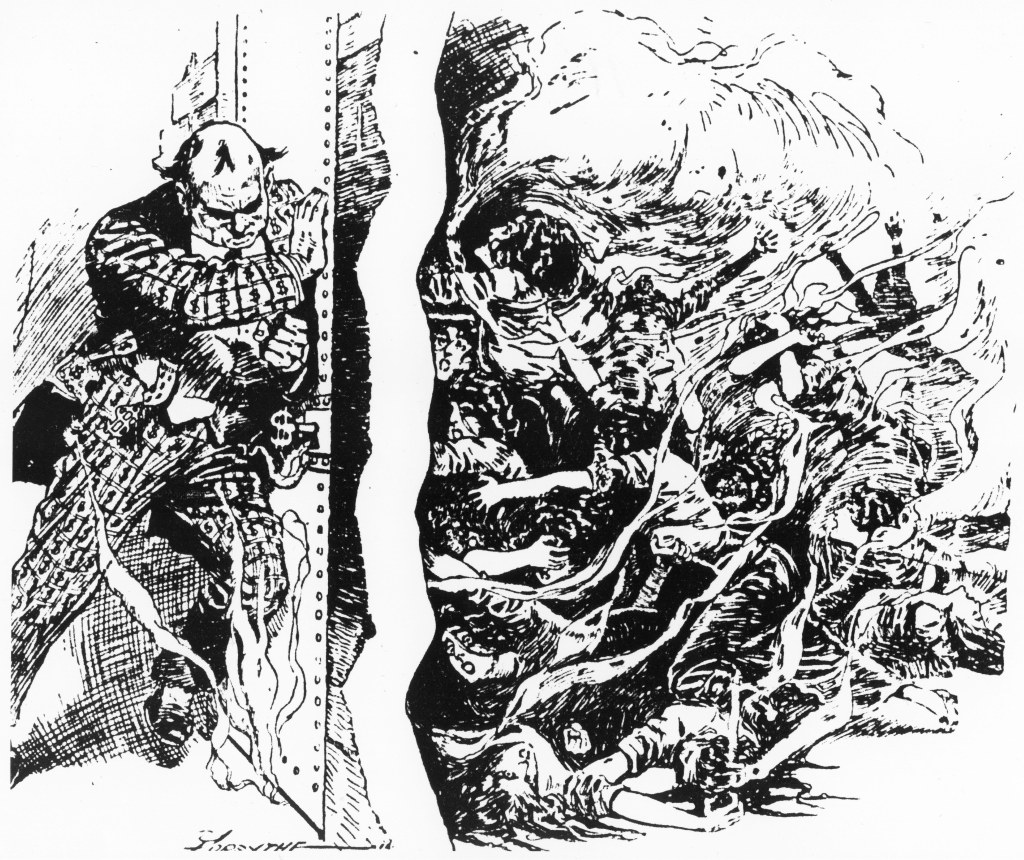
The fire spurred demands for improved working conditions. Newspapers covered the protests, trial, and movement toward laws about workers’ compensation and factory regulations. Editorial cartoons on the topic helped garner support for change. Look at this editorial cartoon and then Cornell University’s collection.

Kheel Center / CC BY (https://creativecommons.org/licenses/by/2.0)

What messages are conveyed? How could these cartoons persuade readers to believe that change is necessary?

Many other horrific workplace accidents have happened because of a lack of safety measures. Although it is grim to think about, these tragedies led to reform and legislation that greatly shaped working conditions for future generations. Why do you think laws had to be passed to reduce workplace dangers? What laws pertain to safety that are in place today? Research the history of the Occupational Safety and Hazard Administration (OSHA) to learn about contemporary regulations.

The Podcast of the Past: Create Your Own Old-Timey Radio Show!

More than 900,000 podcast shows are currently running, a number that continues to climb. Why are they so popular, especially among younger consumers? Just as important, how did they come to be?

It’s interesting to think that this seemingly new phenomenon is actually one of our older forms of entertainment. Just like podcasts, radio shows of the 1920s-1940s appealed to an array of listeners and spanned genres. In fact, many of our TV genres came from radio. People listened to sports broadcasts, news, cooking shows, competitions, and variety spots, backed by live musicians. Fictional programs were also common, with westerns, mysteries, soap operas, comedies, and kids’ shows. Listen to the first radio episode of the Adventures of Superman:

This 1938 short film shows the making of a radio western:

As you can see here, sound effects were an important part of radio production. You might also remember this scene from the 1982 film version of Annie:

This article provides a good overview of the process of creating sound effects, not with a computer, but with common household objects.

Listen to the introduction to The Adventure of Sam Spade (1948):

Note how the advertiser is mentioned several times within the introduction. Now listen to the set up. How does the music set the tone? How do the characters set up the story? Can you picture the characters? How do they establish the scene without visuals? What sound effects do you hear?

Creating your own radio show
First, figure out what kind of show would you like to make. A western, like the first video? Variety show? A mystery? Once you’ve determined the genre, start planning out your specifics. How many people or characters will you have? Describe the people involved and the setting for your show. Remember, you don’t need costumes or sets, but you should be able to paint a picture for your audience using descriptive language.

Plan out the story. If it’s a variety show, who will host? What will your acts be? For fiction, who is the main character? Other characters? Villain? What will happen in your story? When? Have a script or clear plan for your show and create a fitting title.

Next, think of the extras. Which parts of your show could use sound effects? Identify the sound and then the household object you could use (ask your parents first). For example, rice poured into a bowl can sound like rain. Find shoes with hard bottoms to exaggerate footsteps. Gather your items and plan out when they will be used.

Finally, figure out a fake sponsor of your show–any product will do, but it’s even better if it ties into the theme and/or audience of your show. Listen to the incorporation of Ovaltine into this original 1936 Little Orphan Annie broadcast. Use a similar pairing for your show.

Once you’ve planned out your show and its sponsorship, rehearse your show several times through before you perform or film it. Everyone involved should know what to do and when, including the sound effects.

When you are ready, either perform your show live or have someone film it (share on Facebook, if you’d like). Have fun! You could even do a podcast in which you reflect on the experience.

Understanding Media Sources in the Pandemic

Why can’t we have sleepovers, play on the playground or go climbing? What have you heard about coronavirus (COVID-19)? How does it spread? Who can get it? What happens if you do get sick? At this point, I’m sure you’re heard a lot of different pieces of information, most of it probably from other people. Today, I want you to focus on doing your own research, gathering facts from credible sources.

What are credible sources? “Credible sources” refer to organizations and media outlets known for producing fact-based, trustworthy information that has undergone a gatekeeping process (meaning several tiers of people check and verify the information before it is released to the public).

We’ll start with health organizations. For health issues, the Centers for Disease Control and Prevention (CDC), national public health institute for the United States. Use the CDC’s resources on COVID-19 to answer the following questions:

1. How does the COVID-19 spread?
2. What are the symptoms of COVID-19?
3. How can your family prepare if someone gets sick? What should you do?

The World Health Organization (WHO) is a global public health agency and has produced wonderful resources about COVID-19. Look at WHO’s page of mythbusters. Identify 3 myths about what can kill the coronavirus.

We can also turn to news outlets for information. Like other news sources, The New York Times and The Washington Post have produced a plethora of stories on coronavirus, covering many angles on what it is, how the disease affects groups of people, and its profound impact on society. With news stories, it is important to look at the source and the date. Articles written about coronavirus in January had a very different purpose and tone compared to stories produced this week. Compare this January 29th story: “New York is Bracing for the Coronavirus” to this one from today, in which there are more than 15,000 cases: “New York Prepares for a Week at the Pandemic’s Center.” What was the purpose of each story? How has the tone shifted?

Compare local news to national news or look across media platforms. Broadcast news stories (television news) are packaged differently than ones created for print and online sources. For example, watch this Nashville News Channel 5 broadcast and discuss its focus.

What are not credible sources? We have what feels like unlimited media choices. It can be hard to tell what sources we should trust. How do you determine what are not credible sources? If “information” does not have to pass through a gatekeeping process (or doesn’t reference a source that does), it may not be credible. Social media posts, blogs, memes, email forwards, and personal websites are all examples of media content with no screening process. Anyone can create posts or memes and publish them, without others checking the information.

This doesn’t mean that we can’t learn from these types of media products, but take them with a grain of salt (be a little skeptical about the information). This means that if you read something about coronavirus on social media or on a website, look up the information using a credible source (organization or news outlet-produced) before you believe it, or even worse, share it with others.

For example, a number of people shared this meme on social media about preventing coronavirus by gargling salt water [FALSE INFORMATION].

Why do you think people believe in such “remedies?” Even worse, why do people share “information” even though it has no factual basis?

News stories and factual resources are vital at this tough time. Knowing where to look for credible information will help us stay updated and not be misled by fake remedies or other myths of the coronavirus.

Stop Telling People to Wash Their Hands: The Myth of Responsibility in the Pandemic

Image may contain: one or more people, possible text that says 'Exhibit A...Coronavirus swab. Yes that is where the swab goes. So unless you'd like this done to you... u...stay home and wash your hands!!! Please. Facebook/MedicalMemes'
Meme going viral right now

This meme is going around social media. Along with these:

Plus parody songs that time washing hands, instructional videos on how to get that lather, and a shortage of anti-bacterial soap that demonstrates people are listening.

So I don’t seriously think you should stop washing your hands. It should have been standard practice. And yes, we could all use a little reminder to linger at the sink and up our thoroughness.

That said, I have several issues with this message as the dominant one we’re still reciting, meming, and sharing. Back in January, this “wash your hands” campaign was a good introduction to the escalation about to come. And yet we’ve spent more time repeating this phrase than sharing vital information from the CDC, World Health Organization, public health departments, and other sources.

We are past the initial stage of the crisis and should be focusing on identifying symptoms, where to go for testing, how to protect yourself from infecting others, and what to do for yourself if you don’t need hospitalization. This is the information we should be spreading online.

Using risk language (like in the meme above) simplifies disease transmission into a Magic Bullet Model. Under this falsely-conveyed causation, if you test positive for COVID-19, then you must have failed at washing your hands or not touching your face. This is not how disease works. Transmission, susceptibility, and immunity are complicated. We don’t know exactly how each person got infected so we need to stop assigning blame for those yet to be infected. And with that, stop blaming people from other countries too. It won’t protect you. Instead, treat everyone like they are Tom Hanks, Rita Wilson, or Idris Elba.

Here’s the deal: We need regular people to feel comfortable coming forward and sharing their personal experiences so stop stigmatizing individuals who have tested positive (and the many who likely have the disease but aren’t being tested). It is helpful to hear about the varied unfolding of this disease and how it affects different people. We should be thinking about how we can best be prepared and help out, not accusing others of improper hand washing. The when is here. It’s time to shift our own messages accordingly.

(And, yes, we wash our hands).