Guest Post: Becoming your Best Writing Self: Motivations and Goals

Dr. Tanya M. Peres
Associate Professor
Graduate Program Director
Department of Anthropology
Florida State University
tanya.peres@fsu.edu

I recently attended a session with a staff member of my university’s writing center. He led us in a reflection exercise on how we start the writing process, set writing goals, and identify growth areas to become our best writing selves. Today I am sharing a little about my writing process – maybe you will find a trick or tip to put into your process toolbox.

1. How do I get started?

Much of my writing is assignment-driven. You might think it strange that anyone other than students or journalists would have writing assignments, but here we are. Professional assignments have a pre-determined topic or theme, are part of our professional workload, have specific requirements depending on the genre and outlet, and they have a deadline. So, what are these writing assignments and how are they genre-specific?

Conference Presentations

Conference presentations are typically part of thematic research sessions.  These presentations can be either posters or podium papers, and often are on unpublished current research. Presentations are a good way to get feedback from scholars in your field.

Peer-reviewed Publications

These are the ultimate in academic writing assignments. Peer-reviewed publications are the medium used to present data and interpretations, describe a new method or theory, or synthesize existing datasets and qualitatively or quantitatively compare them.

Public Writing

Writing for readers that are not discipline specialists is a genre in and of itself. I find ideas for a story stem from information I want to share, wanting to add another level of meaning or history to a story or topic, or simply a fun fact or story that I think non-archaeologists would enjoy. Sometimes I test out ideas in conversation with friends or acquaintances. Other times, I sketch them out to pitch as an idea to an editor.

No matter what genre of writing I am working on, I try to always start with an outline. Outlines help me figure out the flow of the narrative (or story), things that are necessities to that narrative, and how to best organize the different parts. When I ignore my own best advice and just start writing sans an outline, things go off the rails quickly. I often find myself going down a research rabbit hole that is more often than not on a completely different topic, but fun to read!). Like that time in 2015 when I found a medical brief on a patient with maggots in their nose (no, really, but if you are squeamish, skip the figure).

2. How do I set writing goals?

I start with the assignment due date! If it is a grant proposal, conference paper, or a solicited manuscript (i.e., someone asked me to write something for a journal, book chapter, blog, magazine, newsletter, etc.) it will have a hard deadline. If the assignment is self-inflicted self-motivated, then I have to establish the deadline(s). The author/editor and the press editor agree upon book manuscript deadlines. If you are writing a thesis or dissertation, your advisor, committee, department, and university all have deadlines you must meet. As the good Dr. Foss says “Always meet your deadlines!”

I break the REALLY BIG THING into smaller tasks and assign them objectives (word count, additional research/references needed, etc.), then schedule when I am going to work on these parts. Most days I have an hour or less to work on any given writing project. To stay hyper-focused I close out all social media and email apps, turn my phone to vibrate only, turn it face down, and out of easy reach, and put on writing music (cool jazz is my favorite).

Sometimes I need external motivation to keep me on track. I have been a part of writing groups, writing retreats, daily writing challenges, and the last-ditch “hole-up-in-a-hotel-room-all-alone-for-a-weekend-and-get-the-thing-done” method. All were useful and successful in their own way. Peer pressure and money are sometimes what is needed to get us over a hump.

3. What are some of my writing goals?

By the end of 2020 I will submit the final manuscripts for two different books; finish writing a lengthy technical report; and continue working on the draft of a third book manuscript (to submit in Spring 2021).

What are your writing goals? What is your secret inner writer identity? Understanding our goals and motivations can help us to stay motivated and organized.

Teaching Exercise: The Google Doc Round Robin

Each group starts with a different Google doc.

I’m a big fan of drawing slips of paper for randomly-assigned group works. I also love notecards. The pandemic has forced me to find new solutions to communicating different discussion activities. Cue the Google Doc Round Robin.

Round Robin (the game, not the burger joint) involves each person contributing a little in one spot and then moving on to a new position or objective. In ping pong, this is done by hitting the ball once and then quickly moving to the right, circling the table. I applied this approach to a series of Google docs in my health communication class. We did it to explore the process of creating campaigns for a variety of different audiences. This activity could really be applied to any class topic that can be completed in stages — in-person, as long as each individual has a computer, or through a virtual platform with breakout rooms.

Prep Work for the Google docs

  1. Before class, decide how many different groups you would like to have. I opted for five clusters for my class of 17.
  2. Create the same number of Google docs. Include a distinct header and a file name for each one.
  3. Write out your scenario (or whatever you will differentiate between the groups).
  4. Number and state the objective of each stage. Copy and paste into all of the Google docs. In other words, most of the worksheet is the same, with the variable listed at the top.
  5. On our D2L site, I created a submodule for the in-class activity with online resources and links to the 5 Google docs.

Running the Activity

  1. Split the class into groups or have them form their own groups. On Zoom, you could set up break out rooms.
  2. Assign each group a different Google doc. Explain the activity, emphasizing that they should only complete one stage and stop. List out the rotation for the class.
  3. Have each group start at step 1, reading the tasks and doing necessary research. While the groups are working, you can bring up all of the Google docs on your own computer and see the class progress.
  4. After a set time (5-7 minutes), have each group stop and rotate to the next Google doc.

Doc 1–Doc 2–Doc 3–Doc 4–Doc 5–Doc 1

5. Use this format and rotation as the groups move through the docs and through the steps, building on what the groups before them have written in the docs.
6. On the last step, have the groups summarize their current Google doc, briefly presenting the ideas to the class.

With this approach, students are working both within their groups and with the whole class to complete the activity. It is also easy to monitor which groups may need help since you can access the docs at the same time. For my class, it was a nice break from our usual discussions and prompted them to work together. This activity could be modified for a variety of disciplines, keeping the concept of each group or individual contributing a little to create the whole. Of course, you may not be able to work the Rock into your scenarios.


Top 10 Pitfalls of Thesis Writing

Sometimes a change of scenery is just what you need for that tough thesis section (pictured here: writing at Toyota).

Writing your thesis or dissertation may seem like an impossible task — like someone told you to just run a marathon tomorrow or go roof the historic Victorian off the town square. But as with these monumental activities, thesis writing is best conceptualized as a series of steps for which you are prepared to do. So what are the top 10 common mistakes?

  1. Thinking too big. You shouldn’t downplay your work or undervalue yourself. That’s not what I mean. Thinking too big is believing that you must take on the world’s issues and questions for the scope and depth of your thesis. Your life’s work should not and will not be carried out in this thesis. What you are doing right now is a project, albeit a big and important one, that will lay the foundation for more research projects. It is better to have a more narrow scope and a realistic timeline that to try to tackle the world and never finish.
  2. Thinking too small. On the flip side, the thesis is a big deal and you should treat it as such. This is not the same as the 10-page paper you put off until the night before it was due. Take the time and brain space to work steadily to produce quality work. What will be your contribution to the existing field of literature?
  3. Delay, delay, delay. Excuses will not write the thesis. Working with your adviser, establish both a broad timeline that gets you from coursework to graduation and a more specific schedule for each chapter (or section of a chapter). Make every deadline, even if you are a bit unsure of yourself or the overarching magnitude of the project feels too daunting. Do not accept reasons why you didn’t get that chapter done. Just get it done.
  4. Trouble with your adviser. Let’s back up. If you are still in the planning stages and haven’t picked a thesis chair yet, I encourage you to think hard and do a little investigating before you ask (yes, ask) a professor to serve as your adviser. Have you had this person as an instructor? Do you know the potential adviser’s style? You can ask other grad students what the faculty member is like as an adviser or as a t.a. supervisor. Different professors have different ways of approaching the thesis-writing process.
    This is a big deal and marks the start of a new type of relationship. Don’t be afraid to ask (once again, yes, ask, don’t assume). Be polite, explain why you’d like to work with that person, and briefly state your timeline. Usually, professors agree. When they decline, it’s typically not personal, even if it feels that way. Maybe the faculty member is about to go on sabbatical or has recently been approved for a large grant. You just don’t know.
    If you already have an adviser, but it’s not working out, it is perfectly fine to switch thesis chairs. Have a polite conversation with your current adviser before switching. Never badmouth a faculty member to another professor or student.
  5. Getting stuck in the writer’s block quicksand. We’ve all have certain parts of our projects that feel especially tough. Throughout the thesis process, you will definitely hit obstacles in which the section or chapter just feels too hard to continue. It’s important that you don’t get hung up and miss your deadlines. When you don’t know what to write, first take a little break (workout, take a walk, shower, talk to a friend — whatever works for you). Don’t be done for the day. Just rest your brain. Sometimes doing something else is enough to push you through. If you still don’t know what to write, backtrack and read your previous words to give yourself momentum.
    For a difficult section, I recommend switching locations to a place that seems special and only work on that section. More than 12 years later, I still recall the day I reworked my theoretical framework at a coffee shop. Sometimes just focusing can get you through.
  6. Comparing yourself to others. You are writing your thesis. Period. Don’t get caught up in envying a peer’s progress or comforting yourself about missed deadlines by thinking about a person who took an extra year to finish. Like I tell my children all the time, focus on yourself. It is not fair to look at others’ accomplishments or lack thereof. You don’t know their situations and the comparison won’t make you less of a writer or more of one. As I will elaborate in the next point, grad students need to lift each other up.
  7. Going at it alone without peer support. While you shouldn’t compare yourself to others, you also shouldn’t be a lone ship in the sea of thesis writing. Cohorts are wonderful. If you have one, turn to this built-in group of people who understand what you are experiencing. At the very least, find a writing partner or group. This is not your goof-off buddy, but a person who is equally dedicated to writing when it is writing time and pleasant to chat with on your breaks. You will look forward to writing sessions more if you can share in the experience.
  8. Going at it alone without a mentor. Trying to go solo without a mentor is a mistake. Graduate students, especially Ph.D. students, should try to find a faculty mentor in addition to the adviser. If possible, this person should be outside your department or even your university. It’s good to have additional guidance on thesis committee etiquette, the job hunt, and other issues. Making this connection now will also help you as you begin your first tenure-track position.
  9. Getting distracted. Now is not the time to take on extra projects or to do more additional work than you need to pay the bills. Don’t try out for a play or sign up for unicycle class. Write every day with clear objectives, make your deadlines, and FINISH.
  10. Strike a balance. At the same time, you can’t write for 14 hours straight. It is okay to work on your thesis in 2-3 sessions per day, with breaks in-between. In fact, I recommend this approach. If you are a grad student with kids, this will be your life anyway (just make sure you get some uninterrupted writing time). You should eat food, get enough sleep, exercise, and socialize a bit. Finding a balance actually boosts productivity.

Trust me on these tips. We’ve all been there.

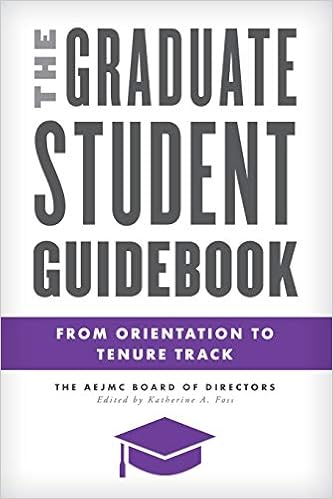
For more advice on graduate school, check out my new anthology: The Graduate Student Guidebook: From Orientation to Tenure Track, written by the AEJMC Board of Directors.

Supplies and tricks to make in-person learning easier for kids (and you)

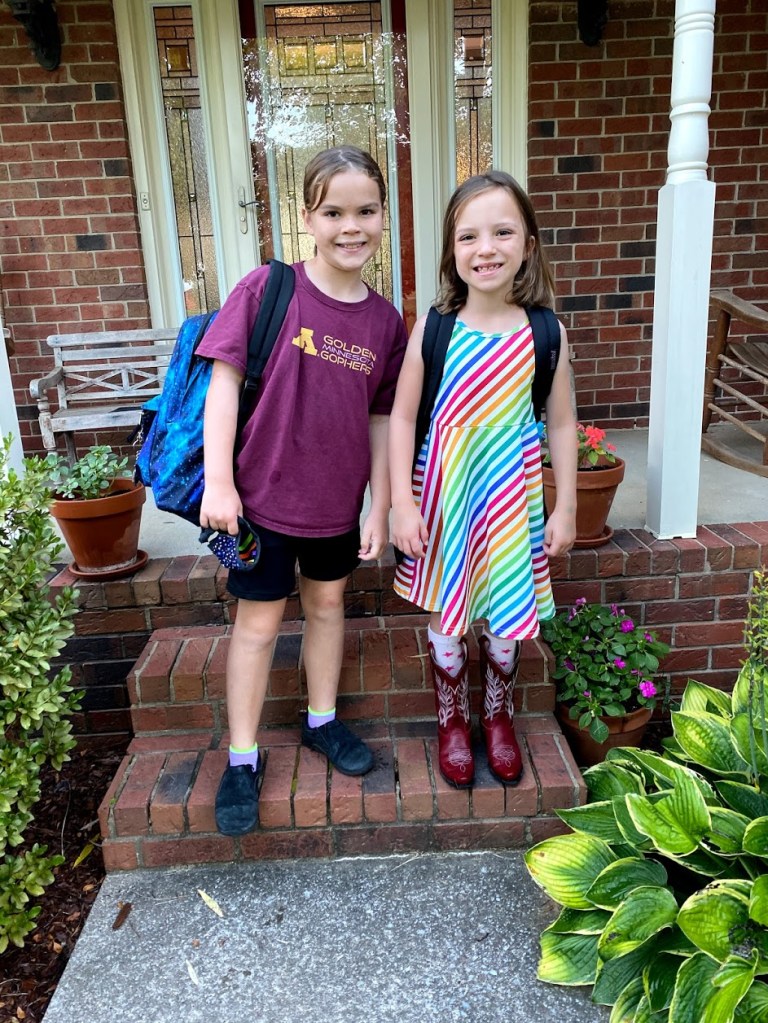
First day of school

If your kids will be at school at all this year, I bet you’re wondering how you can help set yourselves up for success. With all of the uncertainty, this is a tough time. My girls have been physically back in school since August 20th. We’ve figured out a few things over the last few weeks.

School supplies that probably aren’t on the official list

  • Masks (duh, hopefully): Don’t underestimate how many you will need or what type will feel the best for the duration of the school day. Our favorite have been the Old Navy packs.
  • A lanyard or chain to hold the mask: You can get them for under $2 in the craft section.
  • Mints: If they are allowed at school, it’s nice to have a freshener under the mask.
  • Chapstick (for home): Masks can dry out your face.
  • Hand sanitizer: Hands can be sensitive to publicly distributed sanitizer. Bringing your own also saves resources.
  • Sunscreen: At least for my kids, this year has brought extra outside time.
  • A water bottle with a straw: Drinking fountains are likely closed. Straws can be slipped under masks.
  • A lunch: Hot lunch may not be offered.
  • A book: There may be extra downtime as teachers are working through the technology or helping distance learners.
  • A comfortable backpack: With protocol to reduce kids in the hallway, they may not have access to lockers. Consider getting a rolling bag if it is allowed.

Tricks for Fall 2020

  1. Have kids try out different masks and practice before school starts — tie ones, adjustable ear loops, different fabrics, etc. Letting them pick the design is a good idea.
  2. Add a disposable, wrapped-up mask that stays in the backpack as a back-up.
  3. Pack at least two cloth masks plus the disposable to plan for a dropped mask or a change after snack or lunch.
  4. Post a visible list of tasks and items to gather somewhere near the door. There are so many extras this year that it’s hard to keep track of everything. We also have a list for after-school in the hopes that dirty masks make it into the washer.
  5. Get a family calendar and use your digital calendar to help keep everyone on track.
  6. Use a white board to write out tasks and reminders for the next day, especially if activities have started up again.
  7. Build in extra time in the morning. Even two weeks in, waking up has been rough.
  8. Prepare for a few days of tired kids. Having structure for the first time in months can be exhausting.

This is obviously a weird and hard time in which no option is really ideal. As you prepare for the school year’s start, talk with your kids about how things may be different. At the same time, don’t underestimate their ability to adapt. We have had no complaints or resistance about mask-wearing or other additional rules this year. Even in this strange reality, my children are happy to be back, love their teachers, and feel engaged in learning.

Fall 2020: The Challenges of Teaching in a Jenga Semester

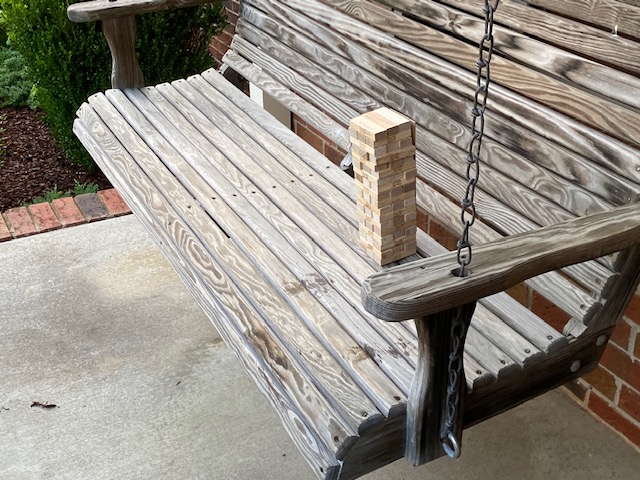
A typical surface for Jenga, sparking memories of the pre-pandemic classroom.

Even with the tension of the first move, rearrangements are easy early on — sliding pieces out and stacking them on top. A few more rounds bring confidence before the precarious state of the unbalanced structure seems to become too much before CRASH!

Our first week of the semester felt like the beginning of the game. Between the Zoom outage and skyrocketing university COVID cases, it was “game over” (at least temporarily) before many players had a turn. For those of us still teaching hybrid, hyflex, web-assisted or whatever you’re calling the partially online, partially in-class experience, week 2 parallels the midway point of the Jenga game.

It’s not just the cloud of potential quarantines and campus shutdowns that threatens this game though. The demands of what teaching now looks like have skewed how the game is even played. Instead of placing the Jenga tower on a flat table in the dining room, it’s as if we decided to foolishly set the blocks on a porch swing.

Jenga on the swing. Not the best idea.

Things may be relatively still or quiet for the moment, but we know that current conditions are unstable at best.

We have to factor in the additional challenges to the initial environment. Add a breeze to the rickety old swing. The technology that enables social distancing-teaching and flexible attendance also burdens us as instructors. We now have to consider whether or not the system is capturing our lectures and if our makeshift classroom spaces will adequately serve the day’s content. Wearing multiple microphones, we have become amplification marionettes and must be careful not to tangle our wires.

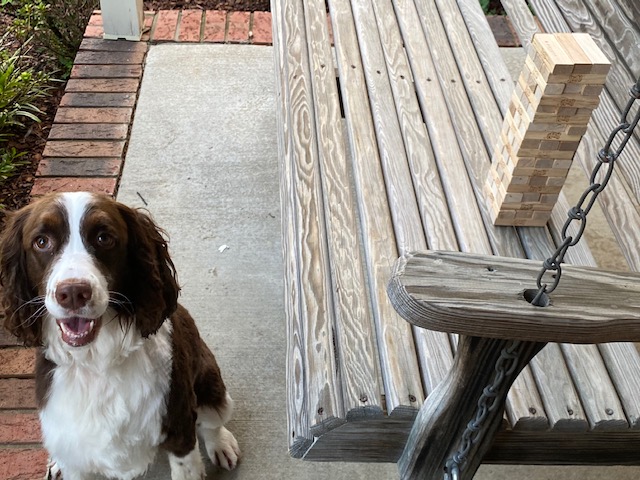
For good measure, let’s let two dogs out to the porch as we play.

This is not going to last long.

Or that’s what it feels like as we find ourselves needing to police the state of classroom health. Was that a sneeze? Or two? Is two too many? Should the student be excused? How do we balance the feelings of one student with the anxiety of the many?

I’m not attacking the protocol of what needed to (and needs) to happen for any in-person classes to occur, nor am I condemning these interactions. My point is to highlight the numerous obstacles shaping our teaching this semester. Just like porch-swing Jenga, we cannot demand “normal.” It’s not going to happen.

We need to redefine expectations. Instead of focusing on class as a vehicle for information delivery, we should aim for the experience itself. Why are we meeting in this way? For me, the real purpose is for us to engage with each other about the course material in (hopefully) meaningful ways. Reducing the emphasis on course objectives helps us to center on class discussion, communication, and camaraderie. All of my good moments thus far have come from student engagement, with me and with each other — the answer to why are we here and even trying this?

This is not a semester for lofty goals or an overhaul of, well, anything. We are already in the midst of that overhaul and must do our best to compensate as we teach on the fly. Much like the Jenga game, we can only take on so many challenges before the tower falls.

Who will clean it up? Will we be expected to immediately play again without changing up the situation or putting the puppies inside?

The game should be the fun part. Picking it all up (especially out of the bush), not so much.

A special thanks to Rosie and Rivet for their participation in my photo illustration.

Teaching a large lecture web-assisted (hybrid) class in the pandemic

Heading off to class back in February. So little to think about back then.

Flexibility, accountability, and backing up the back-up plan will be the only way to make this fall work. Even then, I am not sure how it will play out.

Back in May, my decision to do the mostly in-person with some online context seemed to be the clear winner in the fall choices. I applaud my university for giving 5 options, ranging from in-person to all online. I am also grateful that we could largely decide, based on course content, student needs, and our own personal situations.

I’ve been trying to counter every potential issue with a solution that falls within the range of CDC guidelines, university protocol, student expectations, and my own abilities to make this semester successful. I’ll add that I have been assigned a higher teaching load and thus, have more students than I have ever had. I am also teaching in the student union’s ballroom for my large class, which will provide unique challenges.

My classes are classified as web-assisted, meaning that we have meet in-person at least 15 hours throughout the semester.

Here’s my plan (fully realizing that I may be eating my words in a few weeks):

  1. Problem: A class of 99 students isn’t going to make it very long before someone brings COVID to the classroom.
    Proposed solution: For the large lecture, we will only meet once a week in person. Students can choose to either attend class or they can do a discussion post online. In other words, meeting face-to-face is optional and engagement is measured in different ways. Students can choose week by week which option to do and they don’t have to tell me why. This approach will hopefully reduce the likelihood of students coming to class with symptoms and will cut down the numbers overall.
  2. Problem: Students may resist wearing masks.
    Proposed solution: The university has established mandatory mask-wearing, backed by campaigns to inform students and free masks. I have already reminded students through email that this is the policy and will remind again through Zoom. No mask=no entry into class. Mask off in class=asked to leave.
  3. Problem: Students may have difficulty understanding me, especially since I am teaching in a ballroom and my face is covered.
    Proposed solution: I will also do a separate recording of each lecture (online, not just a recording of class) so that students can clearly see my face through the screen with closed captioning and have a back-up for the lecture. This method also provides the material for students who cannot come to class or opt out.
  4. Problem: Students will be confused about what they need to do to succeed in class.
    Proposed solution: In a semester that demands flexibility, I’m trying to be as consistent as possible. I’ve already posted the schedule, list of assignments, and deadlines. Discussion posts and quizzes will always be on set days. Communication is also going to be key. Even more than in a typical semester, I plan to use email and D2L announcements to convey what needs to be done when. I’m also using the module format and platform calendar to reinforce what needs to be done when.
  5. Problem: Students may be anxious about this semester, especially those who are first-years.
    Proposed solution: This is the primary reason I chose a partially in-person format. I want students that really need the face-to-face (or mask-to-mask) connection to have it. Since some of the anxiety likely stems from the unknown, I’ve already emailed all of my students with our general class plan, including our first day of class Zoom. I also made a brief welcome video on our D2L site and wrote out directions to access our class syllabus. Even if we have to go all online at some point, I will continue offering both a Zoom class discussion and Zoom office hours.

    I’m not sure how this will all work — how long we will get to have class. Obviously, I’m hoping that the optional class to reduce numbers, mandatory masks, and other precautions set forth by the university keep us safe. What I can say is that I will do my best to help students feel engaged and succeed in this very unusual semester.

What Polio Can Teach Us About This Pandemic

Most historical comparisons to our current crisis have been to the “Spanish Flu.” And while several of my essays challenge some of the parallels put forth, I understand why people have been so quick to return to 1918 for answers. Its global reach and profound impact on the U.S. and most of the world feel somewhat similar.

Yet in focusing on this comparison, we miss the series of epidemics that might in fact paint a closer image to our current reality. Throughout the 1940s and 1950s, poliomyelitis emerged periodically in epidemic form, reaching its peak in the summer of 1952. Less than a year later, Jonas Salk’s vaccine was approved for a mass trial, which would prove effective.

What can these polio epidemics teach us about COVID-19? The diseases themselves are not similar. Polio is caused by a three types of a human enterovirus that spreads through contact or contaminated food and water. COVID-19 is a a novel coronavirus, transmitted by respiratory droplets.

What we can relate to is the mystery surrounding the disease. As with COVID-19, with polio, you never knew who would become ill or how bad it would be. Approximately 72% of polio cases were asymptomatic. Those who felt sick usually had mild symptoms. Only a small percentage developed the paralytic form, experiencing either temporary or permanent paralysis of a limb, limbs, the diaphragm, or multiple affected sites–its course unknown. And although it was characterized as a disease of children, adults also contracted polio, particularly in the later epidemics. [Note: I’m speaking in past tense here to refer to the mid-century outbreaks. Polio cases are still emerging in Afghanistan, Nigeria, and Pakistan).

What we can take from the periodic polio epidemics in the first half of the century are ways of living that are accustomed to interruption, the importance of a unified public response, and a healthy respect for disease itself. No one knew when polio would come to town. But when it did, local spots quickly closed down to reduce the spread of disease. People were quarantined and isolated as needed, sometimes even at camps. Movie theaters, public pools, and other gathering places shut down, as parents were advised to avoid having children mingle in new groups. Polio also led to local school closings for short periods, which were opened back up when it was believed that the threat had passed.

No one proposed that polio was a hoax or questioned the severity of the threat. The National Foundation for Infantile Paralysis (NFIP), founded by President Franklin D. Roosevelt and his business partner, Basil O’Connor, united the nation in the fight against poliomyelitis. NFIP campaigns provided education and raised money for rehabilitation and research toward a vaccine. During outbreaks, the NFIP provided additional health professionals and resources, including rocking beds, iron lungs, and other equipment, through coordinated efforts between the local and national levels.

We know the work of the NFIP was successful, demonstrated in the number of people helped and the production of two effective vaccines. At the same time, the NFIP also modeled what can be accomplished in terms of care and research when a nonprofit organization receives long-term public and governmental support.

Polio reminds us of the enigma that is disease. Privilege has shielded developed countries from experience with contagion, causing people to forget its power. In the early to mid-20th century, most people wouldn’t openly resist public health efforts to curb outbreaks. Rather, they were grateful for scientific progress against disease and celebrated the diphtheria antitoxin, each new vaccine, and the introduction to antibiotics.

It is problematic to only look to the 1918 influenza pandemic for lessons. Its first wave was largely unknown, meaning that the experiences of the Spanish Flu were limited to just a few months. As I outlined in earlier essays, we can’t even compare today’s mask mandates to restrictions of that pandemic (and yes, I’ve heard of the Anti-Mask League of San Francisco). Since World War I very much dominated public agenda and therefore, the pandemic seemed to both appear and conclude quickly. Instead, we should learn from the polio experiences. We can remember that we have done this before and can do it again. But, as in the past, we need to support health professionals, public health experts, and those working to develop a vaccine.

Appeared in Vogue and other media outlets

How to Reopen the Schools: Buy-in Across Levels

I’m tired of seeing posts that either protest or promote reopening of schools (both k-12 and college) without trying to explore solutions. I won’t offer advice on when different schools should open. But the fact is, whenever they do open (now, in 3 months, in a year, or ???), every institution, K-12 and higher ed, will look much differently than last February. The key to this possibly working lies in multi-level protocol and support to reduce risk, remain open, and still provide enriching instruction. Obviously, these approaches need to be adapted to specific circumstances.

Mask mandates in school and in the community. We need to both require and enforce the wearing of masks in crowded public spaces. Mandates with enforcement mean that even those who (somehow) “don’t believe in the virus” will have to don a face covering in order to enter stores, schools, and other places. Mask-wearing in the schools is a no-brainer to making this work. But the mask requirement at places of learning will be much more effective if it is the community norm.

Actually rapid testing widely available and free. Cost, access, and time cannot prohibit testing procedures that could make reopening otherwise work. Especially for college students, we need free, on-campus results that can be processed quickly while they wait. With this type of access, professors could build in exposure and testing into the class policies. Combined with contract tracing, this testing could drastically limit both transmission while unknowingly infected and the amount of class and work missed.

Risk-reducing actions built into student codes of conduct. For K-12 students, parents should sign pledges confirming that they will not partake in risk-increasing trips or activities without a voluntary quarantine and testing (weddings and other gatherings, air travel, etc.). Similarly, college students who opt for face-to-face instruction must adhere to a code of contact, in which participation in parties, concerts, or other events could result in disciplinary actions. Tough to enforce, yes, but at least it gives faculty and administration some basis to assign consequences.

Prosocial campaigns on the new protocol. This is a very confusing and hard time for everyone. To get students to comply with our new reality, easy-to-understand messages should be distributed across social media and email, campuses, and the community. These campaigns can inform students, parents, teachers, administrators, other employees, and visitors of what is expected on school grounds and in the classroom before school is in session, including

  • How to enter and exit the building (or each building) and special protocol for entering and exiting (i.e. reminding students not to hold doors for others).
  • Where masks are required and what areas are designated spaces for removing masks.
  • Where to get a back-up disposable mask if something happens to yours.
  • How and where to eat and drink at school.
  • Classroom procedures, like cleaning one’s desk.
  • Other new rules of the year (i.e. no bringing in birthday treats or policies about visitors).
  • What to do if you are feeling sick and/or if you think you’ve been exposed.
  • Procedures for class exposure, including the message delivery, testing, and incubation period.

These campaign messages also set the tone for the school year, helping to convey what is allowed and encouraged.

The importance of community buy-in. Regardless of your party affiliation or even perception of Covid risk, we need to unify to make the reopening of schools work. Simply put, if folks want schools to open (now, 6 months from now, or even later) and stay open, mask-wearing and other protocol has to be implemented and followed. So how can people help and not hinder this success? Let’s look at the different levels.

Parents. After you decide on schooling for your kids, it’s time to look for the good in the situation. No teacher/professor-bashing on social media or to their kids. This has been and will be hard for every person involved. How can I help? should be the only response. Have kids pick out cool masks and practice wearing them. Talk about how the year will be different, highlighting the positives at the same time. Make sure to tell your children that there will likely be unexpected “breaks” and Covid testing. Parents of college students should also be supportive, gently prompting their kids to communicate with instructors if something seems unclear. At the same time, dissuade your college student from attending risky activities.

Students. This new protocol is not optional. By now, anyone over the age of 3 is old enough to understand that we wear masks in public and why. If kids and (especially) college students don’t perceive themselves at risk, the threat of a shutdown should be enough rationale to abide by the rules.

Administrators. I don’t think I have to say be proactive or have back-up plans. Obviously, we do and many are already being rolled out. What I will say is that for teachers and faculty to do their best during initial opening, administration needs to be both flexible and mindful of the strain on educators, especially for those who are also caring for others.

Everyone else. Alumni, store owners, and other members of the community, for schools, and, well, society to safely reopen, it’s time to follow the rules and put aside self-centered behaviors. Play your part in helping the world put this pandemic in the past.

Conversation-starters in the new Baby-Sitters Club series for parents and kids

The Netflix Baby-Sitters Club adaptation is delightfully engaging in such a way that parents and tweens can watch it together. And they should. The 10 episodes of season one are more than just a nostalgic nod. This adaption truly brings Ann M. Martin’s series to life, infusing the 1980s stories with contemporary characters and a surprising array of complex issues. Prosocial without the cheese, this show presents a number of topics that emerge naturally in the narrative. From a parenting perspective, these moments are great segues into discussions about (sometimes difficult) topics. Hopefully, you’ve had a chance to watch the series. Otherwise, spoilers ahead.

BSC Conversation Starters: Overarching Themes

  • Entrepreneurship and Innovation. An easy one since the whole premise is a 13 year-old’s business idea, plan, and implementation. You can discuss why the BSC ultimately succeeds, while the Baby-Sitters Agency does not. Ask your kids what kind of business they would like to have. What would it take to carry out the business (i.e. cost, supplies, people involved, marketing, etc.)? Is it feasible right now? Or in a few years? You could also read more about successful kid entrepreneurs.
  • Friendship. What are the characteristics of a good friend? How can you resolve a fight? We see several escalations smoothed out in the different episodes.
  • Adaptation. Fans of the books and graphic novels cannot resist discussing narrative and character adaptation in the series. What was kept the same? What was changed for TV? Why? In this conversation, you can talk the importance of diversity in representation and that subbing in different physical characteristics doesn’t mean that the character isn’t well-portrayed. Blue-eyed blonde Dawn in the books became a dark-haired Latina in the Netflix series — retaining and extending the traits of the original character. More broadly, you can discuss the process and challenge of adapting books into movies and TV shows (check out this post on adaptations).

BSC Conversation Starters: Episodic Themes

The Netflix adaptation doesn’t shy away from difficult topics. In fact, it seamlessly integrates many issues in a non-threatening, stigmatizing way.

  • First Periods & Menstruation. Given the age group of the BSC, it makes sense that menstruation might come up. It’s nice to see this natural part of growing up addressed, briefly in the pilot and then directly in “Kristy’s Big Day” (adding a second meaning to the “big day”).
  • Gender Identity. A topic that is so important, yet may be difficult to bring up out of the blue. “Mary Anne Saves the Day” by defending her babysitting charge, Bailey, insisting that the health professionals treating her use the correct pronouns. Not only does this moment highlight problems of trans-treatment and patient advocacy in health care, it also demonstrates the agency and empowerment of young people. Earlier in the episode, Dawn casually explains gender identity to Mary Anne in a non-judgmental, easy-to-understand manner. Their fictional conversation prompted a good real-life chat for my kids and me.
  • Internment of Japanese Americans. The forced relocation and imprisonment of Japanese Americans during World War II is often omitted in historical recaps of the era. In “Claudia and Mean Janine,” Grandma Mimi’s stroke leaves her painfully recalling memories of an internment camp as a child. This storyline naturally leads to a history lesson about what happened in the U.S. during WWII that isn’t usually talked about.
  • Protesting Injustice. Dawn and Claudia lead a peaceful protest against the staff in the “Camp Moosehead” episodes about the inequality of camp activities. It’s a relatable narrative that’s easy to connect to bigger, real-life issues of injustice.

We shouldn’t dismiss the value of enjoyable popular culture. Rather, we can use shows like The Baby-Sitters Club as a bridge to important discussions. Considering how hard to reach tweens and teens can be, it’s helpful to have a ticket into these conversations.

Screen-free, Low-groan Activities for Older Kids

Picking blueberries at a nearby farm. Fun, productive, and delicious.

Entertaining little kiddos can be pretty easy. “Here’s a box.” “Ooh, look at the bubbles!” “You found a lady bug. What’s its name?” Older children are not so easily amused. I can only imagine my 11 year-old’s eyeroll if I suggested that she paint a rock or line up sticks in the driveway.

It’s tough to figure out the days. We are so over the early quarantine theme days. No more “learning to sew” or baking artisan bread time, at least for now. Educational online classes have lost their appeal. At this point, what we really need[ed] are non-screen, fairly easy things to do that don’t feel like more work. With my delightful almost-10 year-old niece visiting, I’ve been trying to figure out activities to entertain and engage two tweens.

Non-screen Activities That Even Tweens Enjoy

I brainstormed ideas that we could do together, in town, that would keep us reasonably separated from other people. For our outings, we arrive close to opening, wear masks if we’re inside, and are willing to leave if it’s too crowded. We’ve been hiking, biking, and playing tennis for the last few months so I left them off the list.

Cooking Novelty Foods

Early in the pandemic, we had an unsupervised food-coloring explosion incident so I’ve been a little reluctant to let the kids cook again. When they asked to make a box of Jell-O, I agreed. AHA! The girls followed the recipe and had a good time in the process. Two hours later, we sampled the jiggly pan and then laughed about how Jell-O used to be a potluck staple. Even though most of it went into the trash, it gave them something to do.

Walkie-Talkies in the Yard

I’m not exactly sure what the appeal is, but apparently when you give walkie-talkies to kids, outside time is a lot more fun. The tweens have spent a few mornings testing out the walkie-talkies, inside and out.

Donut Picnic

This is something I’ve done since my kids were little. We bring donuts to the park and eat breakfast there. Still a favorite and easy to do even when everything was shut down.

Picking Blueberries

A great pandemic tween activity since it’s outside, away from others, and the kids are big enough to actually help. It took us about 40 minutes to pick more than a gallon of blueberries. Bonus activities: planning out and then making delicious blueberry treats.

Going to the Farmer’s Market

We go almost every week. It’s a bit different now, but still an outing that we all enjoy (even the tween). There’s something about choosing or growing vegetables yourself that makes you want to eat them more — except turnips.

Bowling

Our local place does both a Monday special and a kids’ summer bowling program. We went right at 11. It wasn’t crowded, every other lane was kept empty, and the balls were already at each station. We really enjoyed getting to do something that wasn’t at our house.

Painting Pottery

I am not a crafting person and I’m pretty tired of trying to scrub paint off the dining table from crisis-schooling murals. Going to The Pottery Place on 1/2 price seating fee day provided painting fun that I didn’t have to clean up. We got there right at opening and had our own table and paint.

As you can see from the bowl I made, I’m not much of a painter.

Kayaking

We haven’t done this yet, but we’re all excited for our upcoming trip. There’s a few places nearby where you can rent boats for a reasonable price, either to paddle around one spot or to travel down the river and then take an open-air shuttle back to the car. It’s fun even to plan for our kayaking adventure.

Creating That “Summer Feel”

It’s been emotionally beneficial for us to try out activities that differed from our crisis-school isolation time. Adding to the list here, we intend to catch fireflies, make lemonade, and do many of our other regular summer things. Despite what the kids really want to do, they are not spending all day glued to their tablets.